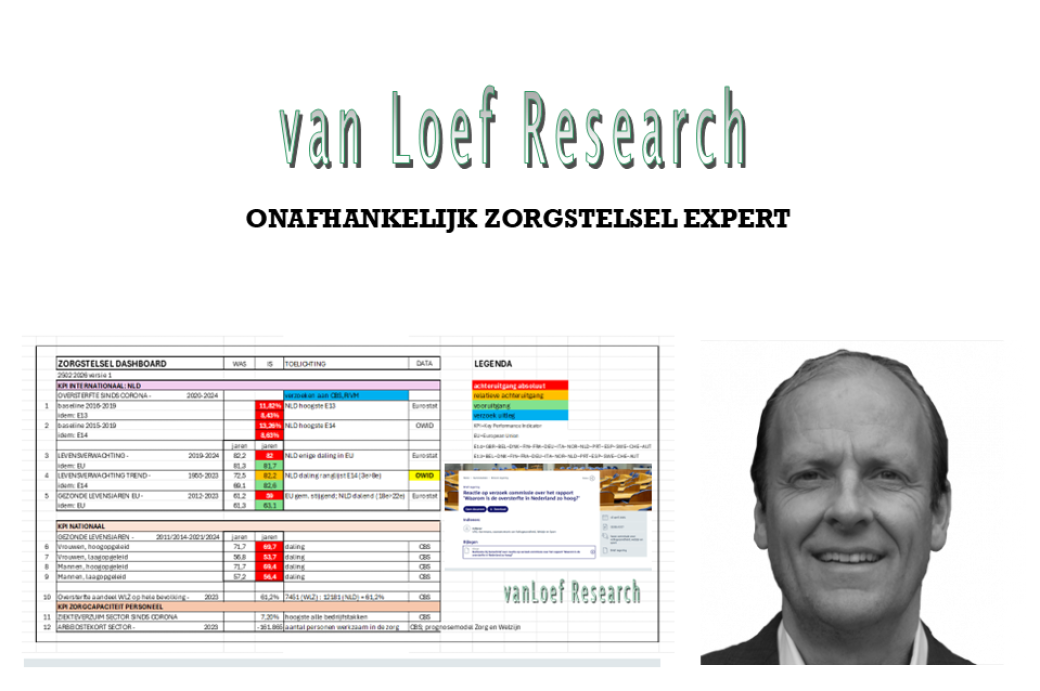
1765 views (website & LinkedIn) – Likes van o.a. 4 zorghoogleraren (bestuurskundig/economisch/medisch), hier op LinkedIn – veel persoonlijke reacties van medici en wetenschappers

VOORAF vanLoef Research bestudeert alleen de gezondheidsontwikkelingen in West-Europa (zorgstelselvergelijkingen) en doet dit sinds 2015. Er zijn 2 perioden: pre-corona en post-corona.
De uiteindelijke conclusie is: De marktwerking in de zorg faalt.
Bron (NB: Preprint): Temporary Shock or Lasting Scar? Life Expectancy Trajectories Since COVID-19 | medRxiv
Abstract The COVID-19 pandemic led to substantial life expectancy losses globally. Historically, life expectancy reversals have been followed by rapid returns to previous trajectories, but whether this is true for the COVID-19 pandemic is still unknown. We update life expectancy estimates through 2024 for 34 high-income countries and quantify annual and cumulative life expectancy “deficits” by comparing observed life expectancy with counterfactuals based on pre-pandemic trends. Five years after the pandemic’s onset, recovery remains incomplete in most countries. In 2024, 31 out of 34 countries still had lower life expectancy than expected. Across 2020-2024, cumulative deficits were statistically significant in nearly all countries. We identify four distinct life expectancy trajectories: (a) first wave peak (largest deficits in 2020 with gradual recovery); (b) second wave peak (largest deficits in 2021 with a sharper rebound); (c) late peak (minimal early impact followed by smaller deficits from 2022 onward); (d) prolonged depression (smaller but persistent deficits without a sharp peak). In general, countries with severe second-wave peaks (such as the USA and Bulgaria) had the largest cumulative deficits. In contrast, countries that delayed widespread infection (e.g., Norway, Japan) saw later deficits that persisted through 2024, but with lower cumulative mortality. Our findings suggest that COVID-19 was not a uniform, short-lived mortality shock. Instead, most high-income countries experienced multi-year disruptions to life expectancy trajectories, with variable patterns of recovery that continue to shape population health five years on.
Figure 1. (below) Six countries showed no definitive pandemic “peak” but persistent life expectancy deficits across the whole period (Austria, France, Israel, the Netherlands, Northern Ireland, and Portugal) (“prolonged depression”).
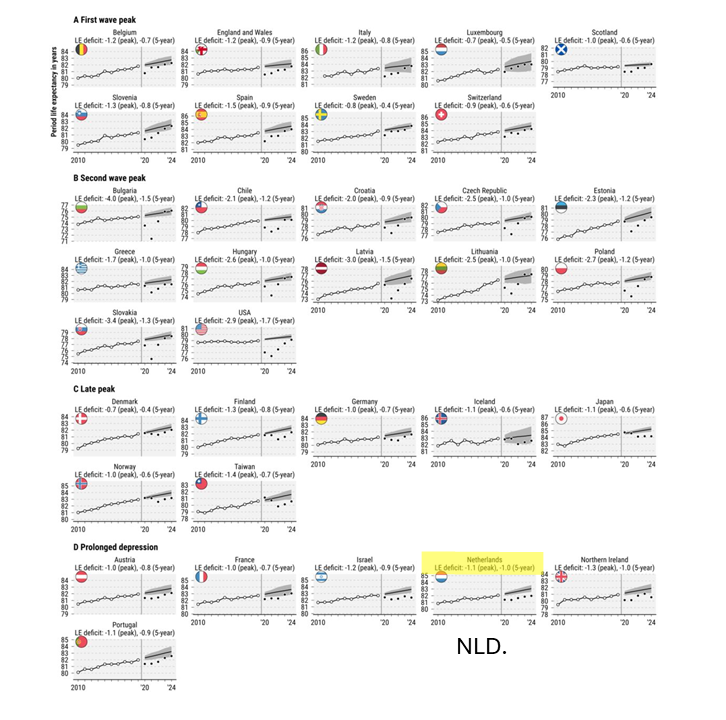
Figure 3. (below) shows country rankings of life expectancy deficits for each individual year and the overall 2020-24 period. Some countries, such as the Netherlands (−1.01 years, p<0.001) and Portugal (−0.89, p<0.001), experienced less sharp but persistent deficits that accumulated to significant losses over the entire period.

Wat doe ik? Beoefening van kritische wetenschap. Mijn bijdragen liggen in de onafhankelijke analyse van de werking van de marktgedreven zorg op basis van een integrale kennisbenadering en analyse van cijfers/kengetallen en oplossingen - de ontwikkelde kengetallen (oa. oversterfte>dalende levensverwachting; arbeidstekort) worden inmiddels breed geaccepteerd. Tevens houd ik mij bezig met het ontwerp van een beter zorgstelsel (publiek primaat; kwalitatief, financieel).

Wat kunt u doen? Steun dit onafhankelijk onderzoek door het te delen en/of neem contact met mij op.
U kunt ook doneren en dan een bijdrage storten op bankrekening NL93 INGB 0104514876 t.n.v. van Loef Research & Consult.
Publicaties oversterfte van nieuw naar oud
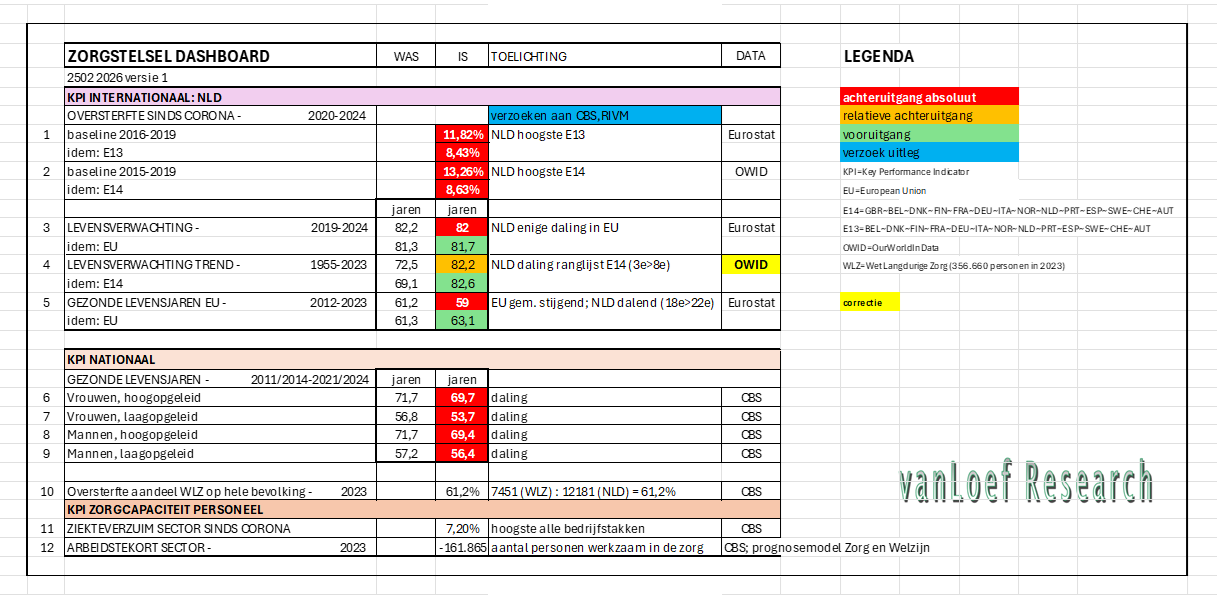
25 februari 2026 – ZORGSTELSEL NLD. DASHBOARD
28 mei 2025
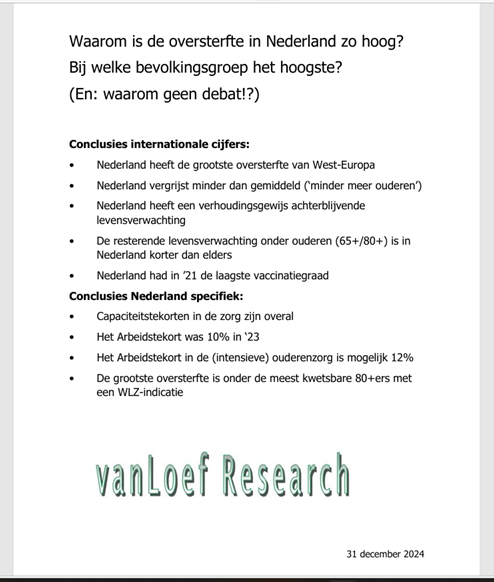
31 december 2024
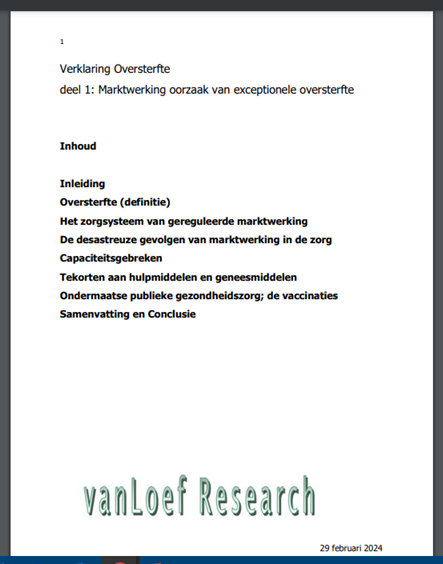
29 februari 2024
2 februari 2024

 Gijs van Loef