Het is simpelweg niet uit te leggen dat een eigenzinnige drs. sociologie zonder inkomen uit arbeid een dashboard neerzet dat een onmisbaar inzicht geeft in het presteren en functioneren van de bewierookte marktgedreven Nederlandse gezondheidszorg.
@Willeke Slingerland – dank voor je inzichten – is dit een casus?
1420 views (website &LinkedIn) – ‘Like’ Jaap van den Heuvel, Dick van der Zon, Kjeld Aij (allen erkende deskundigen) repost Bart Bruijn (huisarts) – de ALGEMENE REKENKAMER is geïnformeerd (27/3)
update – 28 maart 2026
Het bereik van ‘Blik op Nederland’ op twitter is kleiner dan dat van mij (hoe moet ik dit anders formuleren?). De Algemene Rekenkamer is een geverifieerd account, ik ben dan niet (geen inkomsten uit maatschappelijk relevante arbeid!) en heeft ongeveer driemaal meer volgers, twee voorwaarden voor een groter bereik, maar het aantal weergaven en waarderingen van het dashboard bericht is desalniettemin (iets) lager…
Wat een toeval.
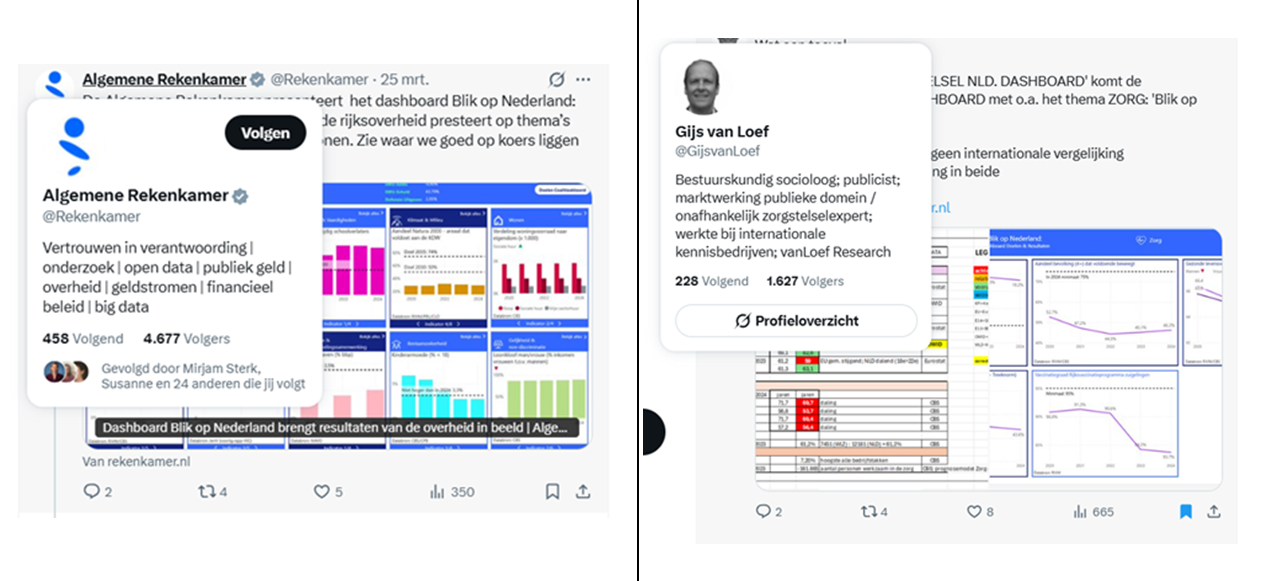
Een maand na het ‘ZORGSTELSEL NLD. DASHBOARD’ komt de @Rekenkamer met een DASHBOARD met o.a. het thema ZORG: ‘Blik op Nederland’!
NB
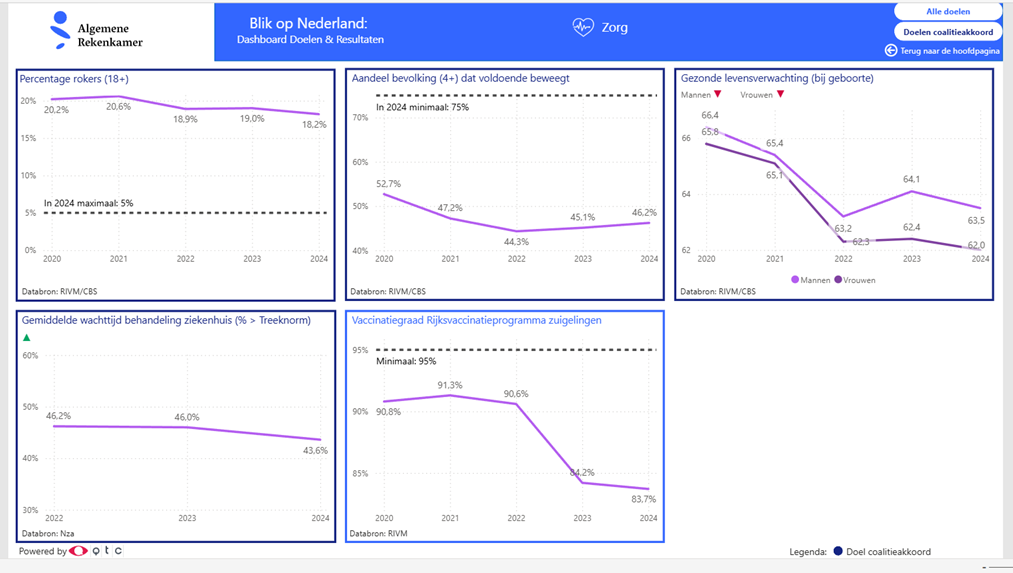
‘Blik op Nederland’ geeft geen internationale vergelijking;
Gezonde levensverwachting komt voor in in beide dashboards
Kritiek
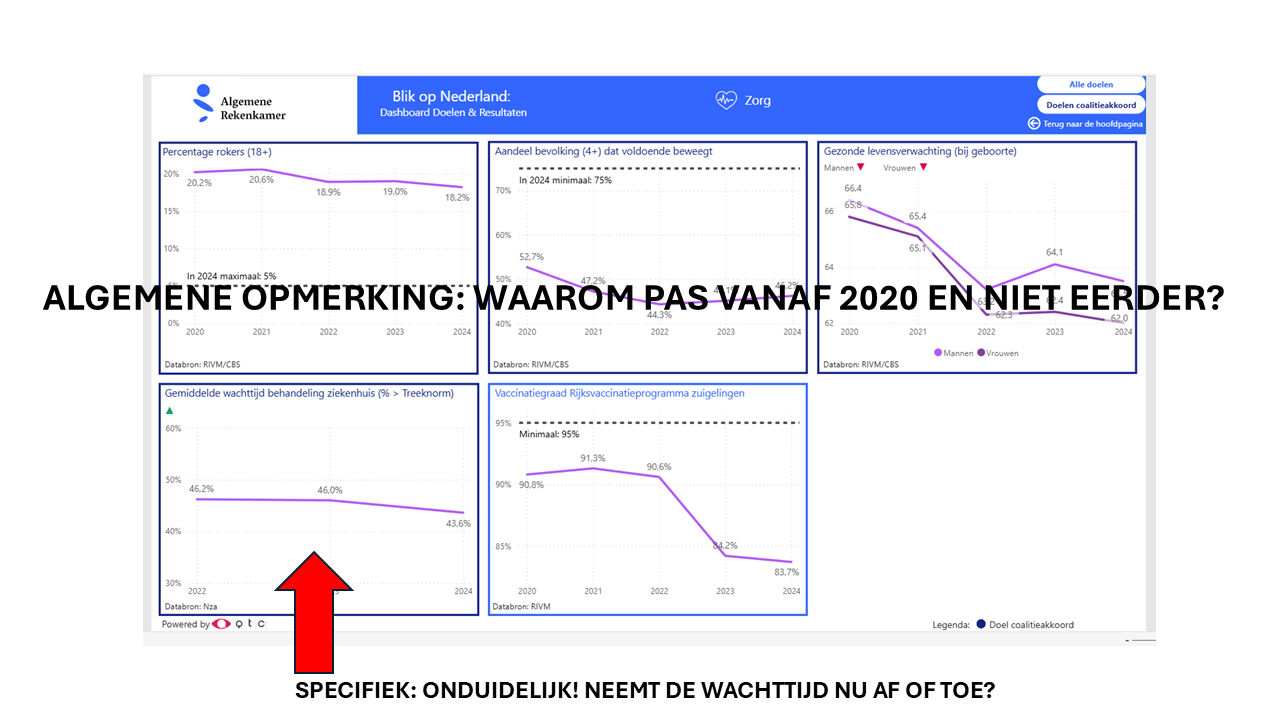
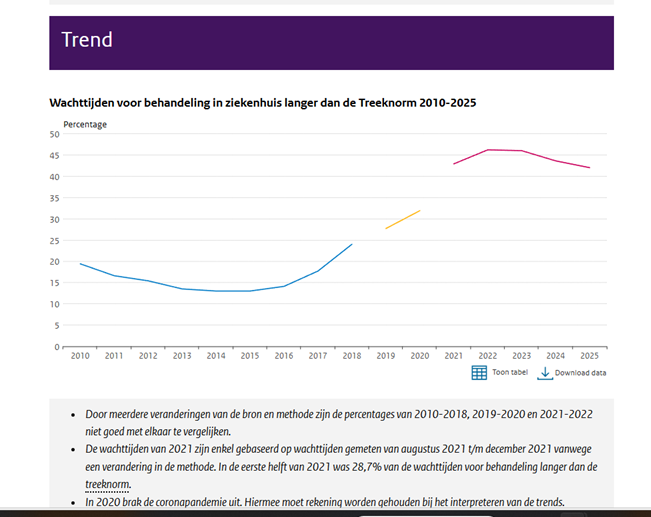
Waarom begin ‘Blik op Nederland’ pas in 2020? 2020 Is een breukjaar, toen begon de corona pandemie. Kengetallen scoorden significant anders in de jaren ervoor. Het zicht op de langere historie, die meer inzicht geeft, ontbreekt daardoor?
In 2024 werd in 43.6% van de gevallen de maximaal toegestane wachttijd, de Treeknorm, overschreden.
Wat doe ik? Beoefening van kritische wetenschap. Mijn bijdragen liggen in de onafhankelijke analyse van de werking van de marktgedreven zorg op basis van een integrale kennisbenadering en analyse van cijfers/kengetallen en oplossingen - de ontwikkelde kengetallen (oa. oversterfte>dalende levensverwachting; arbeidstekort) worden inmiddels breed geaccepteerd. Tevens houd ik mij bezig met het ontwerp van een beter zorgstelsel (publiek primaat; kwalitatief, financieel).

Wat kunt u doen? Steun dit onafhankelijk onderzoek door het te delen en/of neem contact met mij op.
U kunt ook doneren en dan een bijdrage storten op bankrekening NL93 INGB 0104514876 t.n.v. van Loef Research & Consult.
Een maand na het 'ZORGSTELSEL NLD. DASHBOARD' komt de @Rekenkamer met een DASHBOARD met o.a. het thema ZORG: 'Blik op Nederland' NB ▶️ 'Blik op Nederland' geeft geen internationale vergelijking ▶️Gezonde levensverwachting in beide https://t.co/VIxRVVlUtIpic.twitter.com/lirWLw1WN6
Onze kwetsbare 'oudjes' (80+) vallen weer met bosjes om. De oversterfte periode van 8 weken (volgens nieuwste definitie van het @rivm) eist haar tol. De grootste oversterfte van West-Europa, de kortste levensverwachting van 80+. Geen haan die ernaar kraait!@MinPres@ministerVWSpic.twitter.com/PMLyF1Vkp1
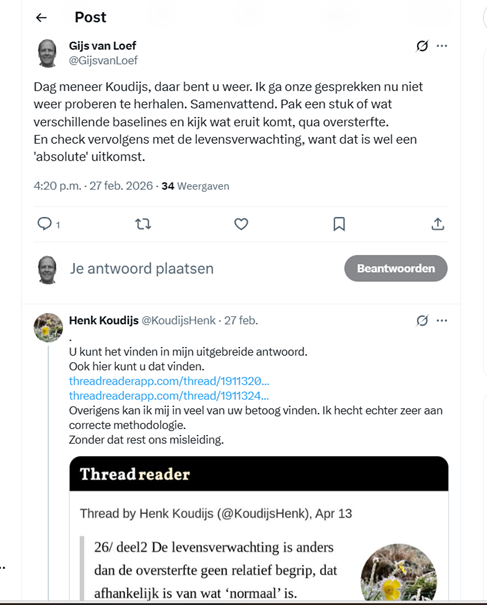
Nee Gijs. Omdat je dit in de openbaarheid trekt, voor de meelezer: zoals ik je in uitgebreide mail uitlegde, heb ik je argumentatie gewoon voorgelegd aan div experts. Die maken er (met prima te volgen argumentatie) gehakt van. Jammer dat je je zo vastgraaft in je eigen gelijk.
Hoho, Maarten. Die argumenten ken ik niet, dan wel zijn onzinnig. De ASMR is de beste maatstaf van sterfte, dat is evident. Maar die wordt slechts 1x/jaar bijgewerkt, Vandaar de EMRs. Nu blijkt dat de wetenschap mij gelijk geeft. Je dwingt me om onze emails openbaar te maken. pic.twitter.com/NDoNwP4hZ2
Je zou je kunnen afvragen of je je lijstje van 'experts' niet eens moet gaan bijwerken. Wie is er daadwerkelijk onafhankelijk (100% noodzaak – niet bij het RIVM en het CBS klaarblijkelijk) EN deskundig?
Beste lezers en volgers, ik ben vanaf nu off-line tot nader order. Vanmiddag naar de Kuip en veel gezelligheid de komende tijd. Laat @volkskrant maar komen. Dank voor jullie steun. Hartelijke groet.
3860 views (website & LinkedIn) – ‘Likes’ van Hans Lugtigheid (econometrist), Hans Verwaart (civiel ingenieur/data analist), beiden zijn al jaren actief publicist op het oversterfte-dossier en Anne Laning (pensioenexpert), drie deskundigen die precies weten waar deze discussie over gaat!– Top25 (24)
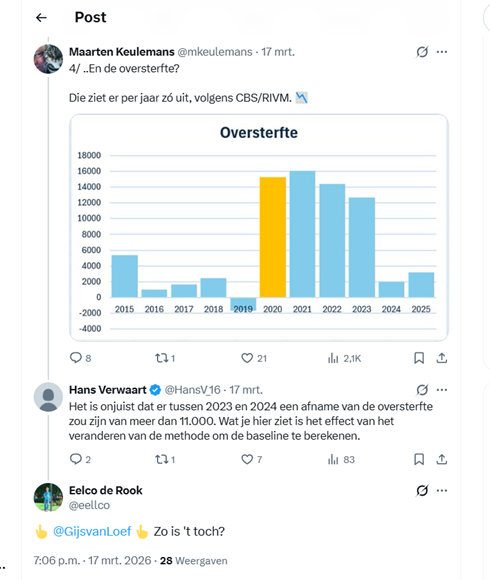
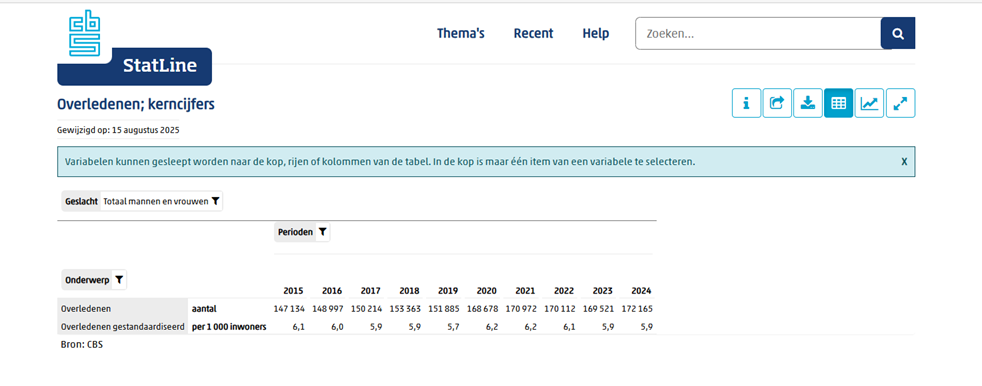
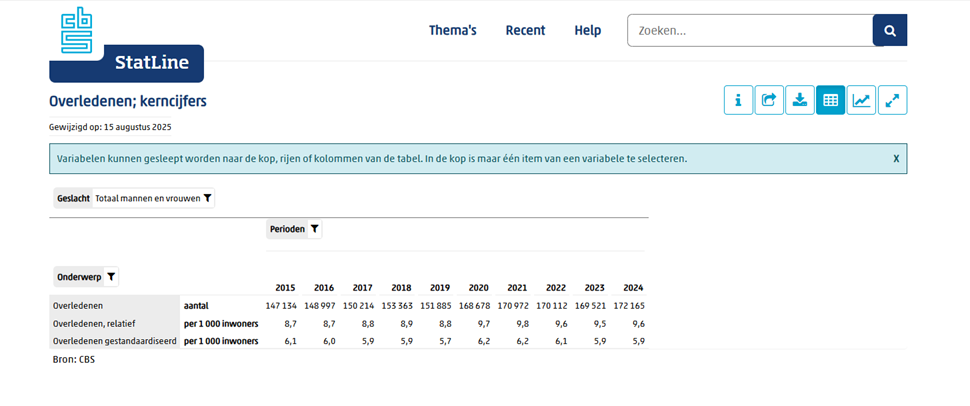
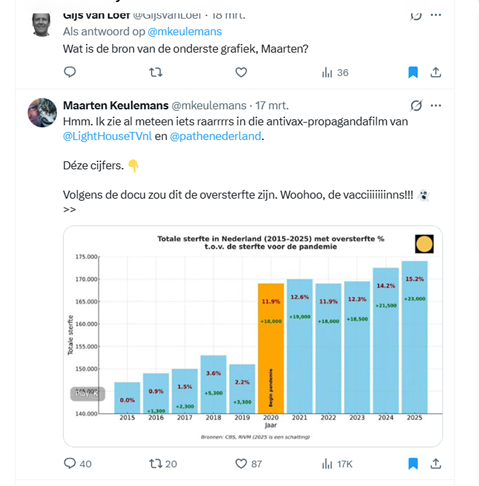
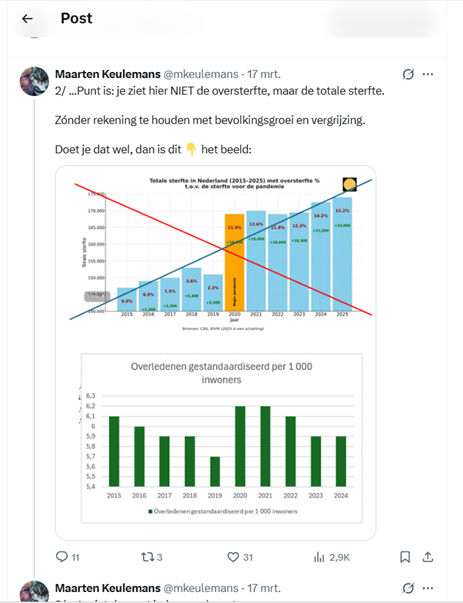
Volkskrant verslaggever @mkeulemans baseert zijn uitspraak (17/3 jl. op twitter/X) dat er geen oversterfte meer is op CBS-statline, tabel: ‘Overledenen gestandaardiseerd’, jaren 2015 t/m 2024
De overledenen-score is in ’23 en ’24 gelijk aan die van ’17 en ’18: 5,9. Er is geen oversterfte meer, aldus Maarten!
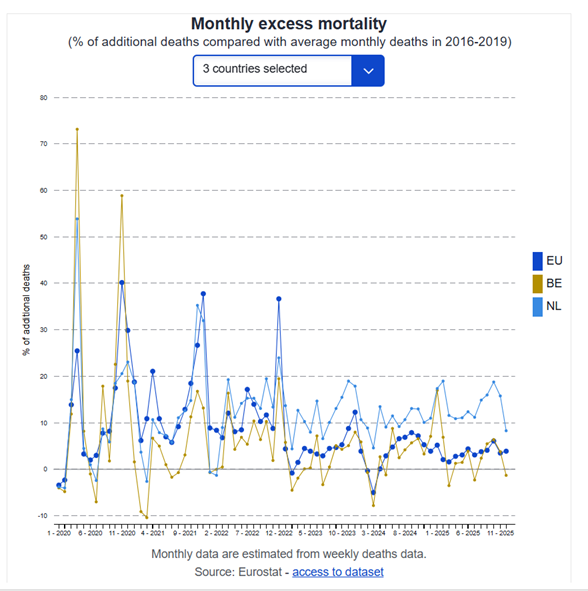
Maar hij pakt de verkeerde parameter, hij moet ‘overledenen relatief’ nemen. Nu is het beeld compleet anders: Sinds 2020 is er aanhoudende oversterfte, van 9,7 (’20) > 9,6 (’24) per 1000 inwoners. In de pre-corona jaren 2015 t/m 2019 lag het cijfer bijna een vol punt lager: 8,7 (’15) > 8,8 (’19).
Rekent u even mee? We nemen het jaar 2024.
9,6 * 18.000 (18 miljoen inwoners) = 172.800 overledenen (NB: kleine afrondingsverschillen, CBS: 172.165).
Gijs, je doet je best maar. Heb je verhaal al lang naast me neergelegd en ben bezig met totaal andere dingen - Maarten Keulemans, voorafgaand aan deze publicatie
Bericht Maarten Keulemans op twitter op 17 maart 2026
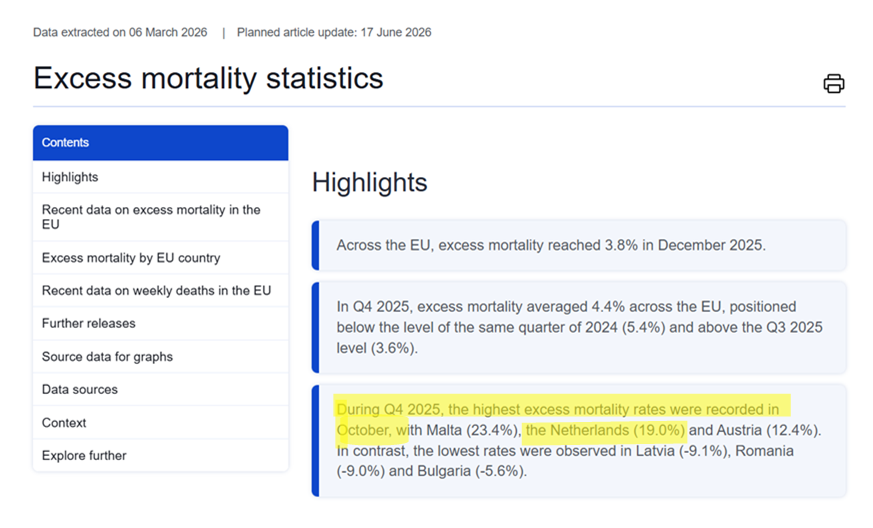
Op 17 maart publiceerde Eurostat de eerste jaarcijfers van 2025. Nederland levert voor het eerst de complete cijfers (per kwartaal) weer aan, net als in eerdere jaren.
1875 views (website & LinkedIn)– Likes van o.a. 4 zorghoogleraren(bestuurskundig/economisch/medisch), hier op LinkedIn– veel persoonlijke reacties van medici en wetenschappers
VOORAF vanLoef Research bestudeert alleen de gezondheidsontwikkelingen in West-Europa (zorgstelselvergelijkingen) en doet dit sinds 2015. Er zijn 2 perioden: pre-corona en post-corona.
De uiteindelijke conclusie is: De marktwerking in de zorg faalt.
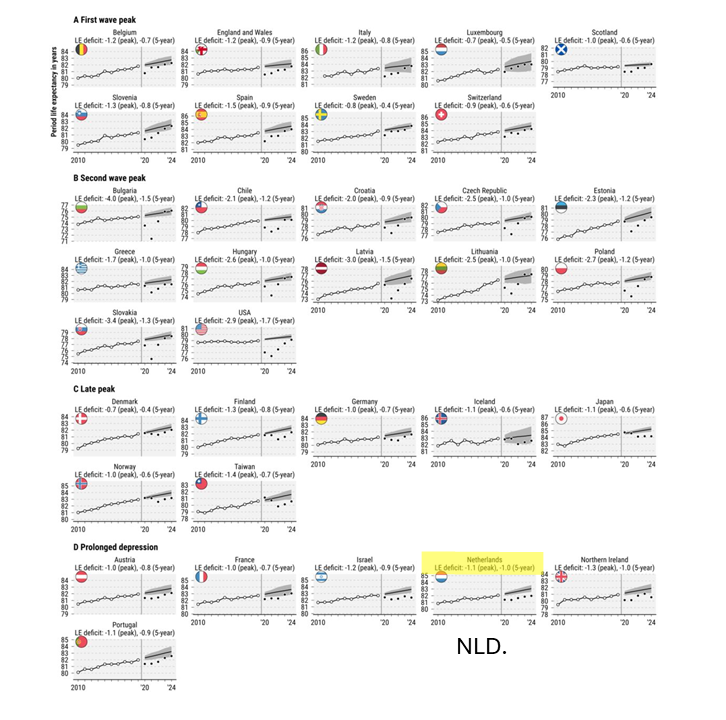
Abstract The COVID-19 pandemic led to substantial life expectancy losses globally. Historically, life expectancy reversals have been followed by rapid returns to previous trajectories, but whether this is true for the COVID-19 pandemic is still unknown. We update life expectancy estimates through 2024 for 34 high-income countries and quantify annual and cumulative life expectancy “deficits” by comparing observed life expectancy with counterfactuals based on pre-pandemic trends. Five years after the pandemic’s onset, recovery remains incomplete in most countries. In 2024, 31 out of 34 countries still had lower life expectancy than expected. Across 2020-2024, cumulative deficits were statistically significant in nearly all countries. We identify four distinct life expectancy trajectories: (a) first wave peak (largest deficits in 2020 with gradual recovery); (b) second wave peak (largest deficits in 2021 with a sharper rebound); (c) late peak (minimal early impact followed by smaller deficits from 2022 onward); (d) prolonged depression (smaller but persistent deficits without a sharp peak). In general, countries with severe second-wave peaks (such as the USA and Bulgaria) had the largest cumulative deficits. In contrast, countries that delayed widespread infection (e.g., Norway, Japan) saw later deficits that persisted through 2024, but with lower cumulative mortality. Our findings suggest that COVID-19 was not a uniform, short-lived mortality shock. Instead, most high-income countries experienced multi-year disruptions to life expectancy trajectories, with variable patterns of recovery that continue to shape population health five years on.
Figure 1. (below) Six countries showed no definitive pandemic “peak” but persistent life expectancy deficits across the whole period (Austria, France, Israel, the Netherlands, Northern Ireland, and Portugal) (“prolonged depression”).
Figure 3. (below) shows country rankings of life expectancy deficits for each individual year and the overall 2020-24 period. Some countries, such as the Netherlands (−1.01 years, p<0.001) and Portugal (−0.89, p<0.001), experienced less sharp but persistent deficits that accumulated to significant losses over the entire period.
Wat doe ik? Beoefening van kritische wetenschap. Mijn bijdragen liggen in de onafhankelijke analyse van de werking van de marktgedreven zorg op basis van een integrale kennisbenadering en analyse van cijfers/kengetallen en oplossingen - de ontwikkelde kengetallen (oa. oversterfte>dalende levensverwachting; arbeidstekort) worden inmiddels breed geaccepteerd. Tevens houd ik mij bezig met het ontwerp van een beter zorgstelsel (publiek primaat; kwalitatief, financieel).

Wat kunt u doen? Steun dit onafhankelijk onderzoek door het te delen en/of neem contact met mij op.
U kunt ook doneren en dan een bijdrage storten op bankrekening NL93 INGB 0104514876 t.n.v. van Loef Research & Consult.
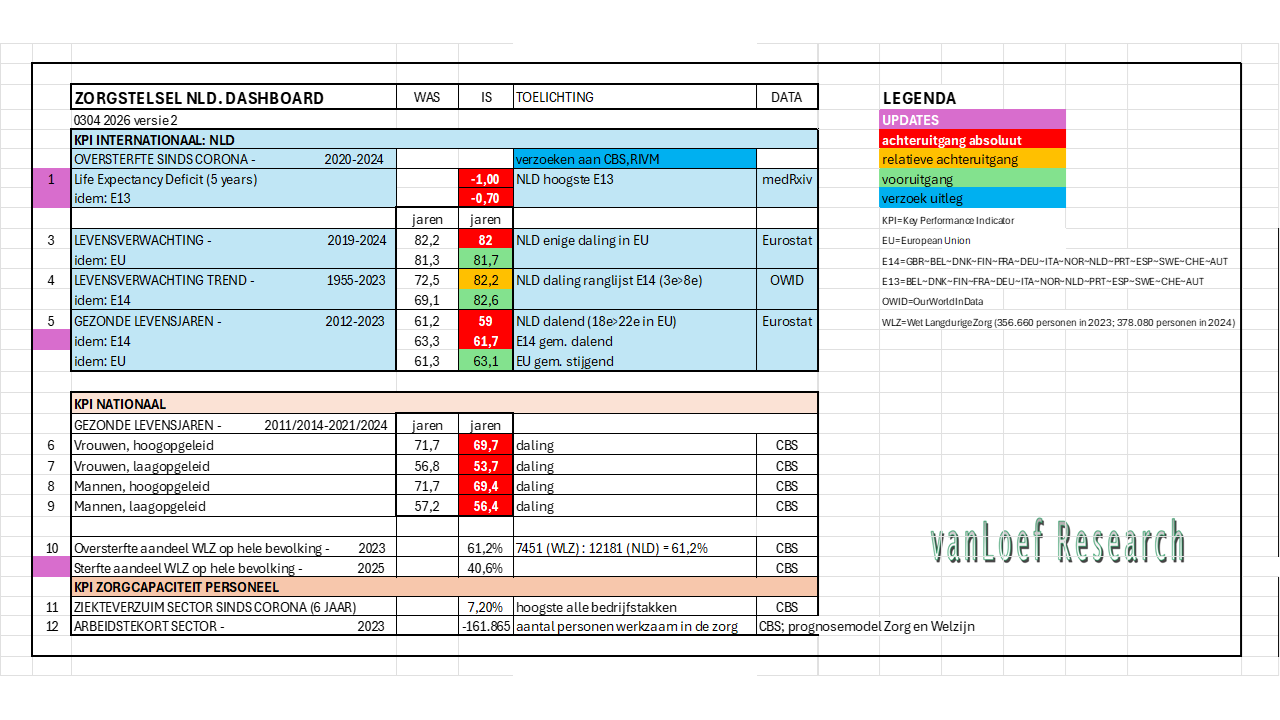
3 april 2026 – update Zorgstelsel NLD. Dashboard (2.)
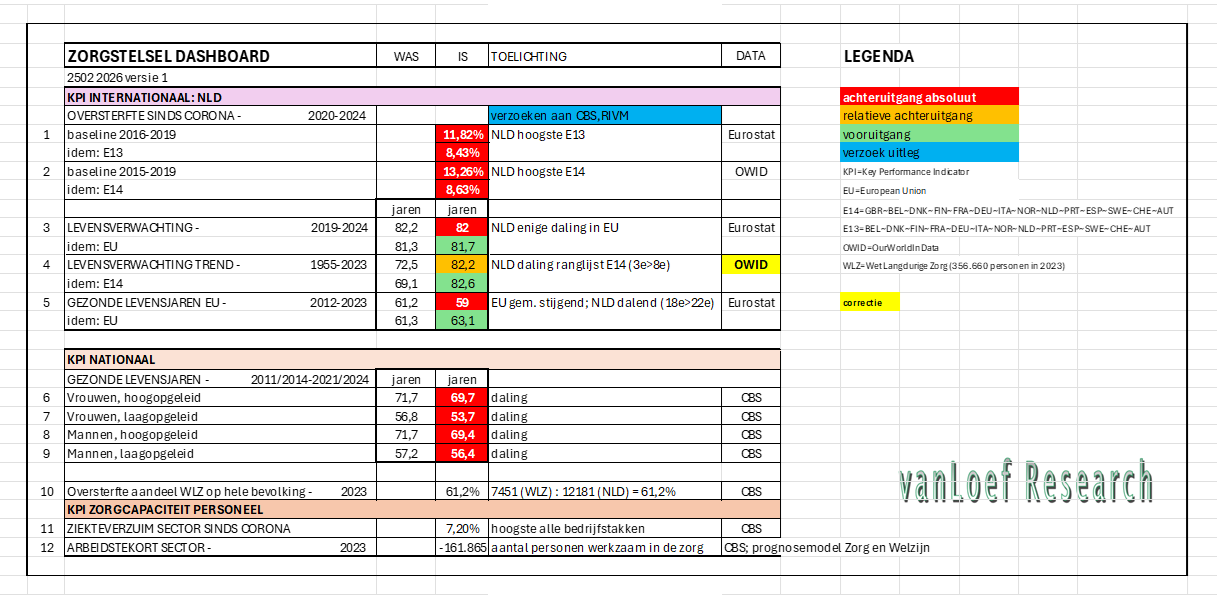
Aanvullingen, dan wel aanpassingen zijn in de kantlijn met paars aangegeven. Het zijn er drie.
kantlijn: 1 – Een nieuwe wetenschappelijke studie in medRxiv bevestigt de analyse en conclusie van vanLoef Research dat Nederland de grootste oversterfte heeft van West-Europa sinds de uitbraak van corona in 2020. Het verlies aan levensjaren (Life expectancy deficit) is in Nederland -1.0, terwijl het gemiddeld -0.7 is in West-Europa (NB: het is een zgn. preprint-studie, in afwachting van peer reviews). De oude Excess Mortality Rankings van de periode 2020-2024 (Eurostat; Ourworldindata) hebben hiervoor plaats gemaakt in het dashboard. Bron: Temporary Shock or Lasting Scar? Life Expectancy Trajectories Since COVID-19 | medRxiv Zie ook:
kantlijn: 5 – Toegevoegd is de ontwikkeling van de Gezonde levensjaren in de E14, de landen in West-Europa. Het laat zien dat er gemiddeld genomen een achteruitgang in gezonde levensjaren is in de E14 sinds 2012. Dit is het geval in negen landen, waaronder in Nederland (NB: geen data Zweden).
kantlijn: 10 – Toegevoegd is het aandeel van de sterfte onder WLZ-zorggebruikers op de totale bevolkingssterfte in 2025.
De Samenvatting, zie de eerste versie hieronder, is verder ongewijzigd.
9 maart 2026
Inmiddels is het 🇳🇱totaalbeeld van de oversterfte, gedaalde levensverwachting en afname van gezonde levensjaren bekend. Het maakt de (op zich terechte) discussie over de baselines achterhaald… 👇https://t.co/x1c6kJF5Rf
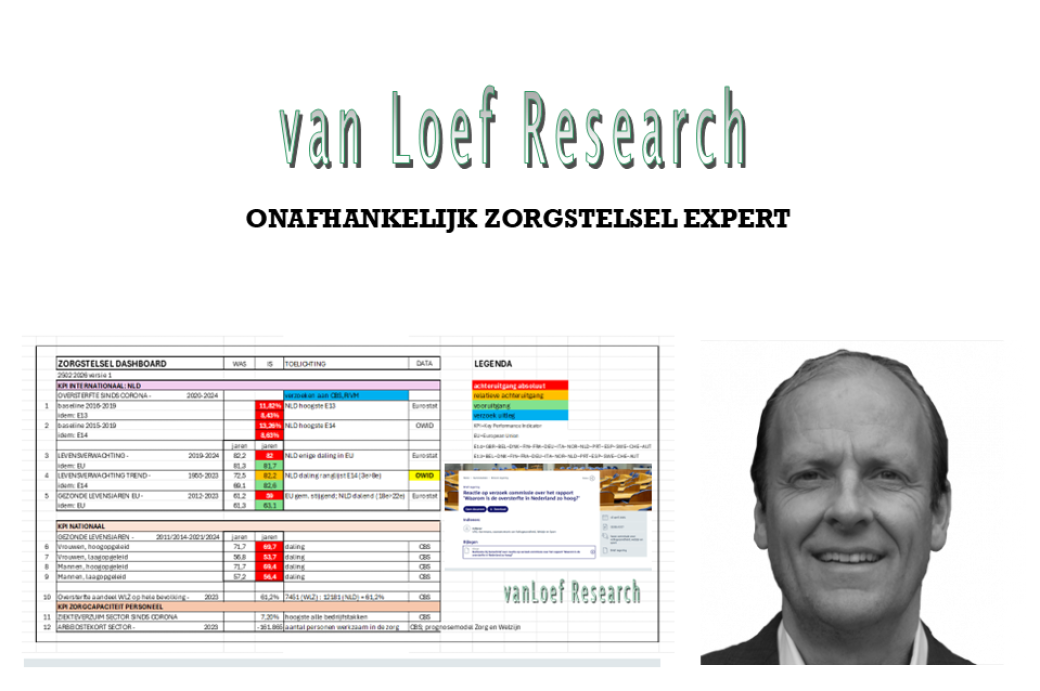
De eerste versie van het Zorgstelsel NLD. Dashboard.
Een internationale vergelijking van de belangrijkste resultaten/uitkomsten (outcomes) van het Nederlandse zorgstelsel op drie Key Performance Indicators: a. Oversterfte sinds corona; b. Levensverwachting bij geboorte (sinds corona); c. Gezonde levensjaren. Plus enkele landelijke KPI’s: d. oversterfte bevolkingsgroep WLZ; e. ziekteverzuim zorgsector; f. arbeidstekort zorgsector.
Samenvatting
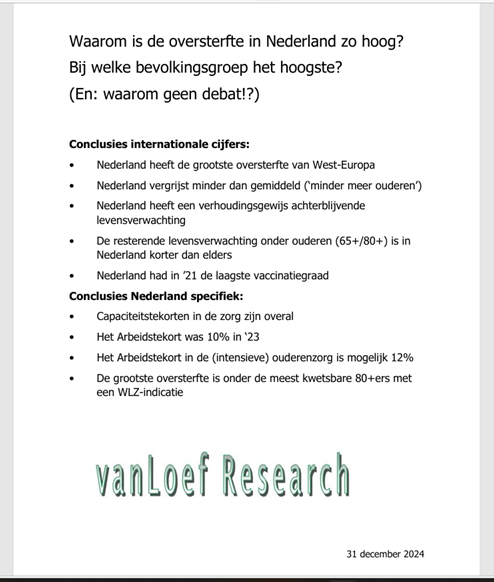
Nederland heeft sinds corona de grootste oversterfte van West-Europa, Nederland is het enige land in de EU waar de levensverwachting is gedaald. Op lange termijn blijft de ontwikkeling van de levensverwachting achter bij de rest van West-Europa. In de afgelopen jaren (vanaf 2012, het moment van de Hoofdlijnenakkoorden in de zorg met sindsdien bezuinigingen op de 1e lijnszorg en de GGZ) is het aantal gezonde levensjaren gedaald, i.t.t. de EU waar het aantal gezonde levensjaren gestegen is.
De daling van het aantal gezonde levensjaren in Nederland is zowel bij laag- als hoogopgeleiden en zowel bij mannen als vrouwen.
De oversterfte trof (in 2023) vooral de meest zwakken in de samenleving: ouderen met langdurige zorg.
De personele capaciteit van de gezondheidszorg schiet ernstig tekort. Sinds corona is het ziekteverzuim in de gezondheidszorg extreem hoog. In 2023 was het arbeidstekort in de gezondheidszorg (openstaande vacatures plus ziekteverzuim) bijna 162.000 werkzame personen.
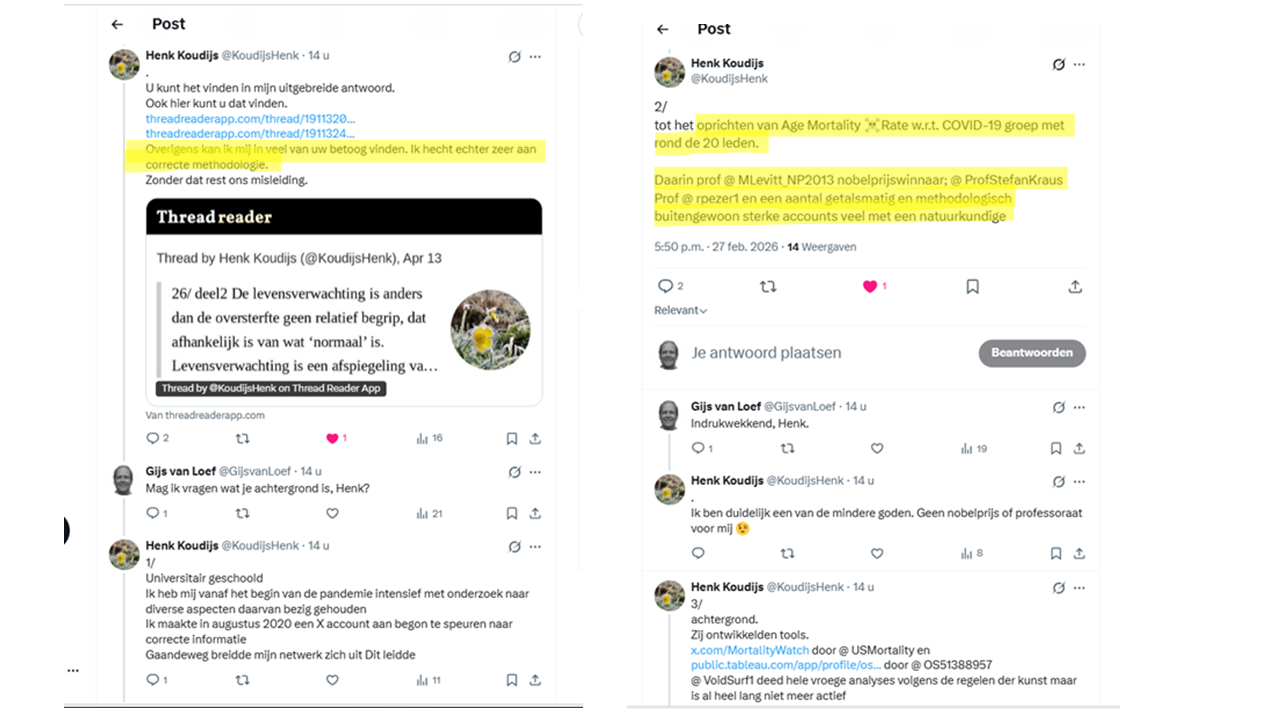
Henk Koudijs was deelnemer aan een kennisnetwerk tijdens covid19 waarbij een aantal internationale deskundigen was aangesloten, waaronder Nobelprijswinnaar prof. Michael Levitt
Maar dat er het afgelopen jaar meer dan 173.000 mensen in Nederland zouden overlijden, dát had het CBS tot een paar jaar geleden niet zien aankomen. „Vóór de komst van corona hadden we de sterftecijfers voor 2025 lager ingeschat”, zegt hoofddemograaf Ruben van Gaalen. „Tijdens de coronajaren is de gezondheid van veel mensen erop achteruitgegaan; zij vormen vermoedelijk grotendeels die ‘extra’ overlijdens.”
Wat doe ik? Beoefening van kritische wetenschap. Mijn bijdragen liggen in de onafhankelijke analyse van de werking van de marktgedreven zorg op basis van een integrale kennisbenadering en analyse van cijfers/kengetallen en oplossingen - de ontwikkelde kengetallen (oa. oversterfte>dalende levensverwachting; arbeidstekort) worden inmiddels breed geaccepteerd. Tevens houd ik mij bezig met het ontwerp van een beter zorgstelsel (publiek primaat; kwalitatief, financieel).

Wat kunt u doen? Steun dit onafhankelijk onderzoek door het te delen en/of neem contact met mij op.
U kunt ook doneren en dan een bijdrage storten op bankrekening NL93 INGB 0104514876 t.n.v. van Loef Research & Consult.






 Gijs van Loef